



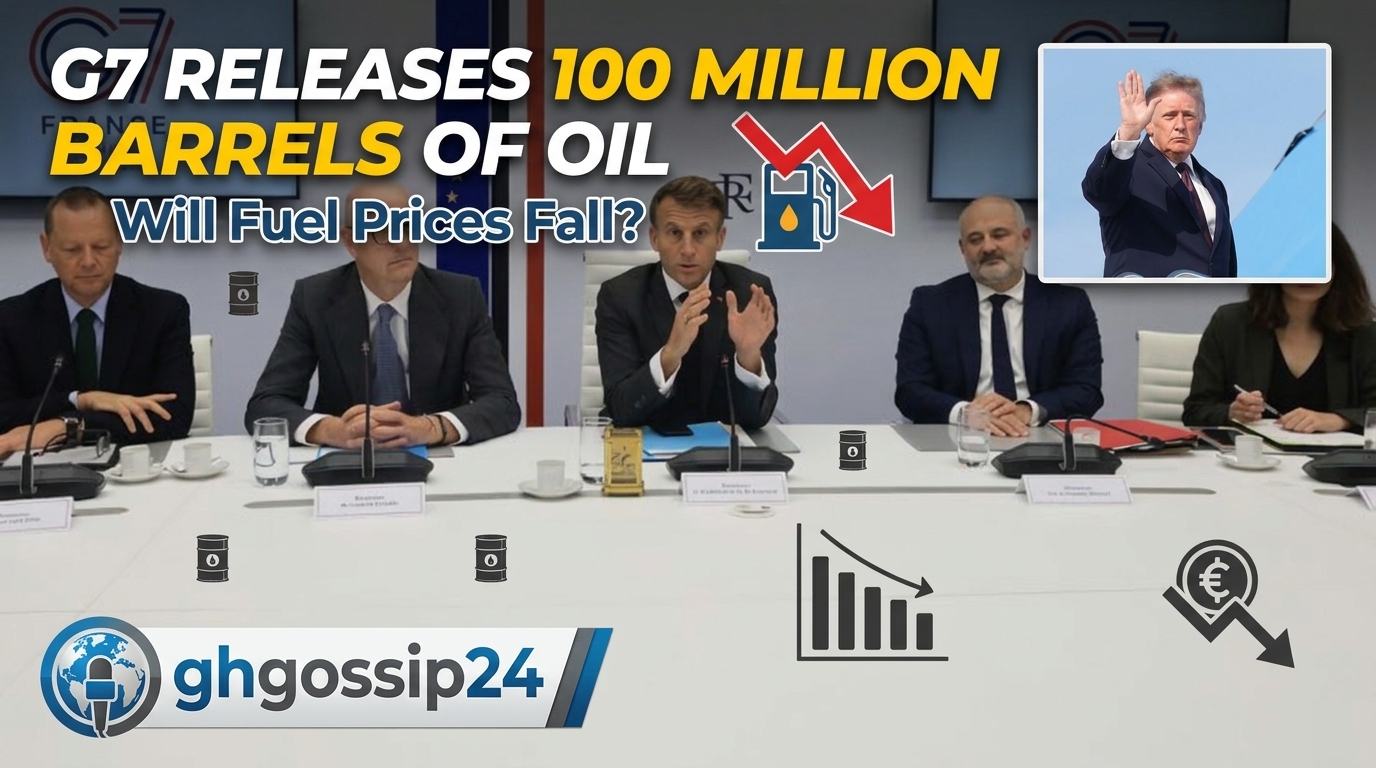
Why the G7 Is Releasing 100 Million Barrels of Emergency Oil
The world’s major advanced economies have agreed to release 100 million barrels of oil and fuel products from emergency reserves as governments try to ease pressure on energy markets and prevent soaring fuel prices from causing even greater economic damage.
The decision was announced after a virtual meeting of the Group of Seven (G7) on October 2, 2026.
The coordinated release will be carried out through the International Energy Agency (IEA) over four months, with a substantial amount of diesel scheduled to enter the market during the first 20 days.
The announcement matters far beyond the G7 countries.
Oil is a global commodity, meaning changes in supply can affect fuel prices, transportation costs, food prices and household expenses around the world.
Why is the G7 releasing 100 million barrels of oil?
The G7 says global energy markets are facing exceptional volatility and that high energy prices are putting pressure on households and businesses.
The situation has been worsened by disruptions to global energy supplies, including problems affecting oil flows through the Middle East and continued disruption linked to the war in Ukraine.
Diesel has become a particular concern.
The G7 therefore wants to put additional fuel into the market while governments work on longer-term measures to improve supply.
Under the agreement, the release will begin immediately and continue over four months. A substantial diesel release will be brought forward into the first 20 days.
Is the G7 releasing 100 million barrels of diesel?
No.
This is an important distinction.
The 100 million barrels refers to a coordinated release of crude oil and oil products from emergency stocks.
However, diesel is being given particular priority because diesel supplies have come under significant pressure.
The G7 agreement specifically calls for a substantial diesel release during the first 20 days, with the possibility of additional releases being discussed through the IEA if necessary.
So headlines saying the G7 is releasing “100 million barrels of diesel” are oversimplifying the announcement.
Who is releasing the oil?
The action involves the G7 countries:
- United States
- Canada
- United Kingdom
- France
- Germany
- Italy
- Japan
The European Union also participates in G7 discussions, although it is not counted as one of the seven G7 countries.
The International Energy Agency will coordinate and monitor the release.
The G7 has also asked the IEA to monitor the effect of the measures on energy security and market stability.
Why are fuel prices so high?
There is no single reason.
Global fuel markets have been affected by several overlapping problems.
The conflict involving Iran has disrupted energy flows and increased uncertainty around the Strait of Hormuz, one of the world’s most important energy routes.
At the same time, the war in Ukraine has continued to affect Russian energy supplies.
These disruptions have tightened the market at a time when demand for fuel remains significant.
Diesel has become particularly sensitive because it is heavily used by trucks, agriculture, industry and other parts of the economy.
When diesel becomes expensive, the effects can spread well beyond the fuel station.
Will the G7 oil release make petrol and diesel cheaper?
It could help, but it does not guarantee a major or immediate fall in prices.
Releasing additional oil and refined products increases available supply.
If the additional supply reaches markets quickly enough, it can reduce some of the pressure that has pushed prices higher.
However, oil prices are influenced by many factors, including production, shipping, refinery capacity, geopolitical events, demand and expectations about future supply.
The G7 itself said it would continue monitoring the situation and could consider additional action if necessary.
Energy analysts have also warned that releasing emergency stocks may provide only temporary relief if the underlying supply problems remain unresolved.
When will the oil be released?
The release is scheduled to begin immediately and continue over approximately four months.
The G7 has specifically called for a substantial amount of diesel to be released during the first 20 days.
That front-loaded approach is intended to address the most immediate pressure in the fuel market rather than spreading all of the supply evenly across the entire four-month period.
What does this mean for petrol prices?
The effect on petrol prices is less straightforward than the effect on diesel.
The emergency release is particularly focused on diesel because diesel markets are currently under significant pressure.
Crude oil released from reserves can nevertheless affect the wider petroleum market because crude is the raw material used to produce petrol, diesel and other refined products.
If global crude prices fall and remain lower, that can eventually reduce wholesale fuel costs.
But the final price motorists pay also depends on taxes, refining costs, transportation, exchange rates and local market conditions.
What does this mean for diesel prices?
Diesel is likely to be one of the markets most directly affected by the announcement.
The G7 has explicitly prioritized a substantial diesel release during the first 20 days.
That could increase available supply at a time when diesel inventories and trade flows are under pressure.
However, whether motorists actually see a large reduction at the pump will depend on how quickly the additional supply reaches individual markets and whether other disruptions occur at the same time.
Could this reduce inflation?
Potentially, yes.
Fuel is an input into almost every modern economy.
Trucks use diesel to transport goods. Farmers use fuel to operate machinery. Airlines use aviation fuel. Factories require energy to produce goods.
When fuel becomes more expensive, companies often face higher operating and transportation costs.
Those costs can eventually be passed on to consumers through higher prices.
If the G7 action succeeds in reducing energy-price pressure, it could therefore help limit some inflationary pressure.
But the effect would not happen instantly and would vary significantly between countries.
What about countries outside the G7?
This is where the story becomes particularly important.
Oil is traded globally.
Countries that are not members of the G7 can still be affected by changes in international crude and refined-product prices.
That includes countries across Africa, Asia and Latin America.
However, the amount consumers ultimately pay for fuel depends on each country’s tax system, subsidies, currency, import costs, refining capacity and local fuel-market structure.
A fall in international oil prices therefore does not automatically mean that every country will immediately reduce pump prices.
The G7 also rejected energy export restrictions
The emergency stock release was not the only measure announced.
G7 leaders also reaffirmed their commitment to avoid energy export restrictions between G7 countries.
They called on oil-producing countries to avoid imposing export bans that could make market conditions worse.
The group also agreed to coordinate refinery maintenance schedules where possible, with the aim of avoiding several refineries being offline at the same time.
The G7 wants to increase the availability of refined products, particularly diesel.
How much emergency oil has already been released?
The latest IEA update provides important context.
The agency said member countries had already released about 325 million barrels of oil and oil products from strategic reserves out of a larger 400-million-barrel commitment announced in March.
The new G7 announcement therefore comes against the backdrop of an already substantial emergency response.
That also explains why governments are paying attention to how quickly strategic reserves are being depleted.
Emergency stocks are designed for serious supply disruptions.
Using them can provide short-term relief, but governments eventually need to replenish those reserves.
Could oil prices rise again?
Yes.
The G7 release cannot remove all of the risks affecting global energy markets.
If shipping through major energy routes remains disrupted, production falls further, refineries experience outages or geopolitical tensions escalate, prices could rise again even after emergency stocks enter the market.
That is why the G7 has asked the IEA to monitor the impact and provide further recommendations.
The group’s statement also says a follow-up report should include recommendations for replenishing emergency stocks.
What happens next?
The immediate focus will be on getting diesel and other petroleum products into the market.
The G7 expects a substantial diesel release during the first 20 days, while the wider 100-million-barrel release continues over four months.
Energy markets will then determine how much difference the additional supply makes.
The IEA will monitor implementation and market conditions.
The G7 has also left the door open to additional measures if the situation deteriorates further.
The bigger question: can the oil release solve the fuel crisis?
The short answer is not by itself.
The release can provide additional supply and potentially calm markets.
But it does not restore disrupted production, reopen shipping routes or permanently solve geopolitical problems affecting global energy markets.
Think of the emergency reserves as a buffer.
They can help governments absorb a sudden shock while other measures are being pursued.
The longer-term solution depends on restoring reliable energy flows and ensuring that enough oil and refined fuel can reach global markets.
Latest update
As of October 3, 2026, the G7 has agreed to coordinate the release of 100 million barrels of crude oil and fuel products through the IEA.
The release is scheduled to begin immediately and continue for four months, with a substantial amount of diesel front-loaded into the first 20 days.
The objective is to ease pressure on global energy markets and protect households and businesses from further fuel-price shocks.
Whether consumers ultimately see substantially lower fuel prices will depend on how the additional supply interacts with global demand, shipping, refinery capacity and the geopolitical situation.
G7 Oil Release FAQs
Why is the G7 releasing 100 million barrels of oil?
The G7 is releasing emergency oil and fuel stocks to increase available supply and help stabilize energy markets amid severe price volatility.
Is the G7 releasing 100 million barrels of diesel?
No. The 100 million barrels covers crude oil and fuel products. A substantial diesel release is being prioritized during the first 20 days.
Will the G7 oil release lower fuel prices?
It could put downward pressure on prices by increasing supply, but it does not guarantee that petrol or diesel prices will fall significantly. Market conditions will determine the final effect.
When does the G7 oil release start?
The G7 agreement calls for the coordinated release to begin immediately and continue over four months.
Who will coordinate the oil release?
The International Energy Agency will coordinate and monitor the release.
Why is diesel getting special attention?
Diesel supplies have been under particular pressure, and diesel is essential for trucking, agriculture, industry and other economic activities. The G7 therefore called for a substantial diesel release within the first 20 days.
Will the G7 oil release affect countries outside the G7?
Potentially. International oil and fuel markets are interconnected, so changes in global supply can influence prices in other countries. However, local fuel prices also depend on taxes, exchange rates, transportation and domestic energy policies.
Last updated: October 3, 2026
About the Author